
Quick answer: Affordable yoga software is software whose total monthly cost in India, including 18% GST on the subscription and any add-ons, is lower than the value of the admin hours and renewals it recovers. As a rule of thumb, keep the subscription under about 3% of your monthly membership revenue, and test it on a free trial before you commit.

Prepared by the Levorofit team (Kognos Infosystem Pvt. Ltd., Dwarka, New Delhi) for yoga studio owners and teachers in India. Figures and rules checked on 13 October 2026.
Affordable yoga software is not the cheapest tool on the market. It is the one whose total cost, in rupees and in hours, is lower than the admin it replaces.
Most studio owners in India reach this question at the same point. A few weekly classes grow into dozens of members across morning and evening batches, monthly and quarterly plans, and a WhatsApp inbox that never closes. Software starts to look necessary, but the real question is what it will cost you in rupees, in tax and in time.
This guide is for studio owners who want to scale without overspending. It covers:
- what "affordable" really means once you add up the full cost
- what yoga studio management software costs in India, in rupees
- the India-specific checks most global comparison guides skip: GST, UPI and WhatsApp
- a simple way to work out whether software pays for itself in your studio
The goal isn't to buy more software. It's to build an efficient studio, and bring in software only where it earns its place.
Why scaling a yoga studio gets expensive
Every new member adds a small amount of admin, and those small tasks compound faster than most owners expect.
The visible costs of growth are rent, instructor fees, marketing and props. The hidden cost is the time spent keeping everything straight: who has paid, who is due to renew, who attended last week, and who has quietly stopped coming.
Indian studios often make this harder by offering flexibility. That is five different expiry cycles for one owner to track, before adding workshops, trial classes, substitute teachers and cancellations.
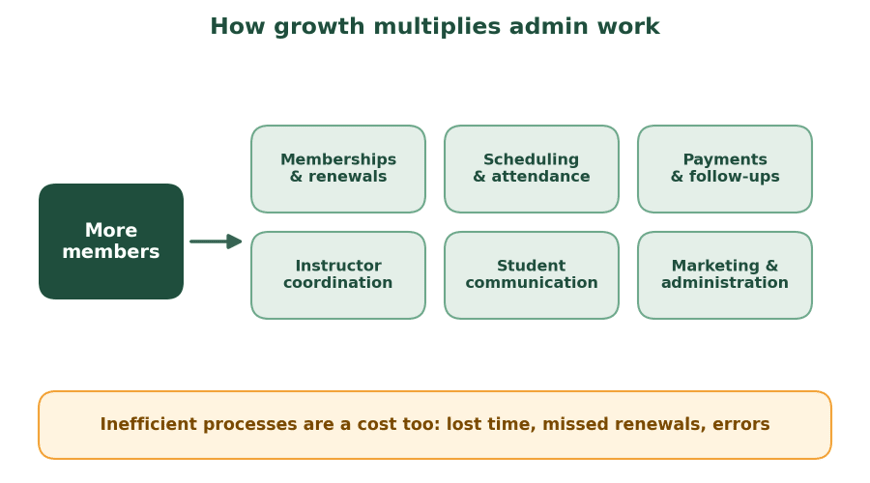
For each member, someone has to track:
- membership type, start date and expiry date
- payment status and mode (UPI, cash, bank transfer)
- attendance and consistency
- contact details and the last time anyone followed up
Inefficient processes are themselves a cost. If you spend six hours a week searching spreadsheets and chat threads, that is six hours not spent teaching, improving the student experience or planning your next batch.
What "affordable" really means
Affordable means the right level of functionality at a total cost that fits your studio, which is not the same as the lowest sticker price.
A free tool that eats five hours of your week is not cheap. A feature-heavy platform your studio barely uses is not cheap either. To compare options fairly, add up everything you would actually pay:
- Subscription: the monthly or annual fee, and how it changes as members or instructors increase.
- GST on the subscription: software is taxed separately from your classes, so compare prices after GST.
- Add-ons: per-message reminder charges, extra instructor seats, and branded apps or custom domains, which often sit on higher plans.
- Payment costs: gateway or card fees on every online payment.
- Billing currency: a subscription billed in a foreign currency costs more in rupees whenever the rupee weakens.
- Switching cost: time to import members, learn the system and retrain instructors.
Then subtract what you stop paying: admin hours, missed renewals, and payment errors.
The right question isn't "What's the cheapest software?" It's "Which system gives my studio what it needs, without charging for complexity it won't use?"
How much does yoga studio management software cost in India?
The most useful way to judge cost is as a share of your revenue, not as a sticker price. A subscription of up to about 3% of monthly membership revenue, before GST, is a sensible ceiling for most studios. This is a rule of thumb we suggest, not an industry standard.
The table shows what that ceiling looks like for four studio sizes. Fees sit within the ₹1,500 to ₹3,500 monthly range typical of independent studios. The studio sizes are illustrative.
|
Studio |
Members |
Average fee |
Monthly revenue |
3% software ceiling |
Per member |
|---|---|---|---|---|---|
|
Solo teacher |
30 |
₹1,500 |
₹45,000 |
₹1,350 |
₹45 |
|
Neighbourhood studio |
60 |
₹2,000 |
₹1,20,000 |
₹3,600 |
₹60 |
|
Established studio |
100 |
₹2,500 |
₹2,50,000 |
₹7,500 |
₹75 |
|
Multi-batch studio |
200 |
₹3,000 |
₹6,00,000 |
₹18,000 |
₹90 |
For reference, Levorofit's published rupee plans run from ₹833 a month (Starter, billed ₹9,990 yearly) to ₹4,999 a month (Pro), with higher plans adding clients, seats and branding. Add 18% GST on top.
Three things can push the real cost above the sticker price, whichever tool you choose:
- Limits. Caps on active students or instructor seats decide which plan you actually need.
- Metered extras. Per-message charges and paid add-ons grow with your studio.
- Billing currency. A foreign-currency subscription drifts upward in rupees whenever the exchange rate moves against you.
What to check in yoga studio management software in India
Two tax and payment rules changed within the past year, and most global software comparisons ignore both. Check them, plus two practical points, against any platform you evaluate.
GST: 5% without input tax credit
Since 22 September 2025, commercial yoga classes attract 5% GST without input tax credit, down from 18% with credit. CBIC has said the new rate is mandatory, so you cannot opt back to 18%. Registration is required once turnover crosses ₹20 lakh (₹10 lakh in special-category states), and yoga run by a registered charitable institution can be exempt.
What this means for software:
- Your invoices and receipts need to show the right rate and your GSTIN, if you are registered.
- Because your 5% comes without credit, GST you pay on a software subscription generally cannot be set off against your own. Compare prices after GST, and confirm treatment with your CA.
UPI: new merchant charges from 15 October 2026
UPI is how most students pay, with 24.07 billion transactions in September 2026. From 15 October, a 0.4% merchant discount rate applies to specified merchant payments above ₹2,000, capped at ₹300 per transaction. Payments up to ₹2,000 stay free, and small merchants receiving up to ₹1 lakh a month through UPI QR are exempt. Students are not charged.
That matters for a studio selling quarterly packs. On a ₹6,000 payment, 0.4% is ₹24, if you fall outside the exemptions. Ask any vendor:
- Do payments go straight to my bank account, or through a gateway?
- What does the gateway charge, and who bears it?
- Are payments matched to members automatically?
WhatsApp: where your students already are
India is WhatsApp's largest market, and class reminders, renewal nudges and payment links usually travel there. Check how the software reaches students: shareable booking and payment links, push notifications, and whether any per-message charges apply.
Support that matches your hours
A payment problem at 5:45 am before a batch is not a problem for a US support team to solve at their lunchtime. Check support hours, channels and language.
When free tools are enough, and when to invest
Free or familiar tools are a good choice at the start. Move to dedicated software when the time they cost you exceeds the time they save.
Software cannot fix unclear processes. It can only make a well-defined process faster, so get the basics in order first: online registration, a single list of members, clear plan expiry dates, a simple attendance record, a fixed way to take payments, and a standard reminder message.
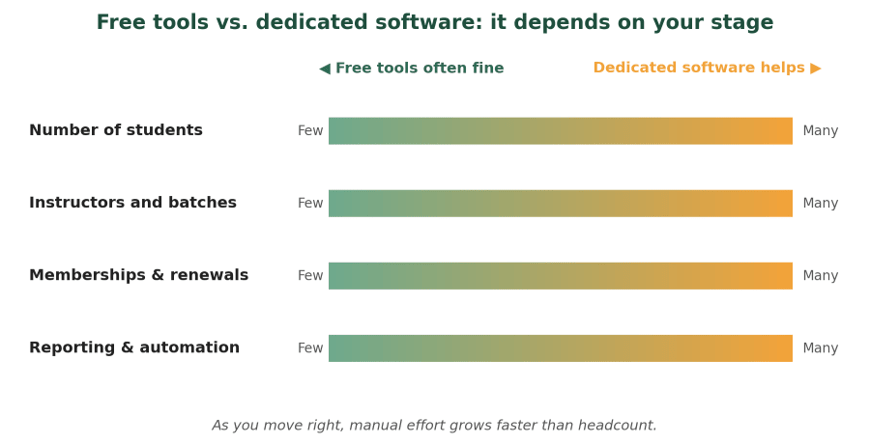
Free tools usually work well if:
- you have a small, stable group of students
- you run a few classes a week
- records are accurate and renewals are easy to spot
- you are still testing your timetable and pricing
It is probably time to look at software if:
- admin takes a noticeable part of your week
- renewals are missed, or you only notice after a student has lapsed
- information lives in spreadsheets, chats, a notebook and a payment app
- you have several instructors, batches or locations
- you cannot say which students are drifting away
There is no magic member count. A studio of 40 with five membership types and three teachers can need software sooner than a studio of 100 with one simple plan. The better question is: how much time and money is my current system costing me?
Is your studio ready for software? A 7-question score
Score one point for every "yes". Five or more means a free trial is worth your time this month.
|
# |
Question |
|---|---|
|
1 |
Do you sell more than one membership type, such as monthly, quarterly, annual and drop-in? |
|
2 |
Do two or more instructors or batches run on the same day? |
|
3 |
Do you spend more than four hours a week on admin outside teaching? |
|
4 |
Have you missed, or noticed late, a renewal in the past three months? |
|
5 |
Do you chase payments by calling or messaging members one by one? |
|
6 |
Could you not say within two minutes which students attended three or more classes last month? |
|
7 |
Do students or your CA need GST-ready invoices? |
- 0 to 2: stay on free tools and tidy your records.
- 3 to 4: prepare. Clean your member list, write down your plan rules, and shortlist tools to trial in a quiet month.
- 5 to 7: start a free trial now and test it against your real week.
Four ways to scale without letting costs climb
Cost control is mostly about removing repeat work, whether or not you buy software.
- Automate repeat tasks. Class reminders, payment reminders, renewal nudges and attendance marking should not depend on your memory.
- Centralise records. One source of truth for each member, not a spreadsheet, a WhatsApp group and a notebook that disagree.
- Standardise your processes. Write down how trials, onboarding, renewals and follow-ups work, so any instructor or assistant can run them.
- Track a few useful numbers. Active members, renewal rate, attendance per member, revenue per member, and trial-to-member conversion tell you more than total headcount.
If you can do all four with free tools, keep doing so. If you are doing them by hand and falling behind, that is the signal to price up software.
How to tell if software is worth the cost
Software pays for itself when the admin time and lost renewals it removes are worth more than its price after GST. Here is the maths with illustrative numbers. Replace them with your own.
Take a studio with 60 members paying an average of ₹2,000 a month, within the ₹1,500 to ₹3,500 range typical of independent studios. The owner spends about 8 hours a week, roughly 35 hours a month, on admin.
|
Line |
Assumption |
₹ per month |
|---|---|---|
|
Admin time saved |
Half of 35 hours = 17.5 hours, valued at ₹300 per hour |
5,250 |
|
Renewals recovered |
4 members a month stay because a reminder went out, at ₹2,000 each |
8,000 |
|
Total benefit |
|
13,250 |
|
Software cost |
₹2,500 plan plus 18% GST |
2,950 |
|
Net monthly gain |
|
10,300 |
|
Net gain if every benefit is halved |
|
3,675 |
The last row is the one to trust. Be conservative, and if the number is still positive, the case is solid.
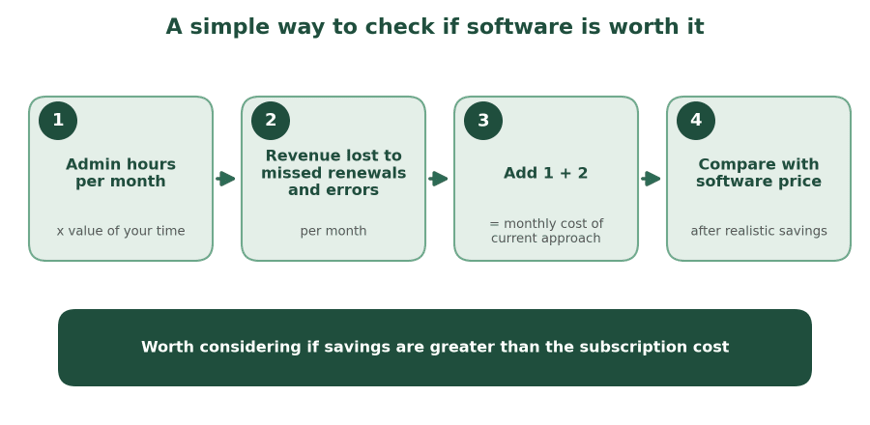
If your honest numbers come out near zero, free tools are the right call for now. Run the same four steps again in six months:
- Estimate your monthly admin hours and put a rupee value on them.
- Estimate revenue lost to missed renewals or payment errors.
- Add the software's price, GST and any add-ons.
- Compare, and use the halved version as your decision number.
Affordable yoga software vs managing everything manually
Neither approach is right for every studio. The trade is direct cost against your own time.
|
Area |
Manual or basic tools |
Dedicated software |
|---|---|---|
|
Member records |
Fine for a short list; gets harder to keep accurate as it grows |
One record per member, with plan, history and notes |
|
Attendance |
Paper or manual entry |
Digital check-in and session logs |
|
Scheduling |
A simple timetable works for a few batches |
Handles multiple instructors, batches and bookings |
|
Renewals |
You check dates and chase members yourself |
Tracked, with reminders and alerts for lapsing members |
|
Payments |
Several records across UPI apps, cash and bank |
Invoices and payment status in one place |
|
Reporting |
Prepared by hand, if at all |
Generated from live data |
|
Cost |
Low cash cost, high time cost |
Subscription cost, with potential time savings |
Where Levorofit fits in a cost-conscious plan
Levorofit is one option worth testing if you want studio management and student wellbeing in one rupee-priced workspace.
It is built for yoga studios and teachers who would otherwise run student and member management, class scheduling, attendance, billing and communication across separate tools. On the yoga side, it adds a 300+ pose library, a breathwork timer, flexibility logs, student wellness profiles, and nutrition planning aligned to Vata, Pitta and Kapha, including Sattvic meal plans. Studio owners also get attendance and growth analytics, at-risk student flagging and campaigns, plus a branded student-facing experience.
Levorofit instructor app: the dashboard tracks students, attendance, revenue and renewals (left); the Practice tab brings class schedule, wellness plans and challenges together (right).
On cost, the published pricing starts at ₹833 a month on the Starter plan, billed ₹9,990 yearly. There is a 30-day free trial with no credit card required, and the page puts average setup at about five minutes. Higher plans raise client and seat limits and add branding, such as a custom domain and a branded mobile app.
The real test is your own workflow. Use the free trial or book a demo, and test the tasks that eat most of your week:
- import your current members and plan expiry dates
- set up one week of classes and mark attendance
- take a UPI payment and generate an invoice with the right GST treatment
- send a renewal reminder
- check how many active students each plan allows, and that it fits your studio size
If your admin still fits comfortably in a spreadsheet, wait. Software is for the point where the spreadsheet starts costing you.
A simple growth roadmap for yoga studios
Introduce each system slightly ahead of the need for it, not years early and not after things get chaotic.
- Small studio: clean member records, a simple timetable, payment tracking, basic attendance and written processes.
- Growing studio: automated reminders, centralised member management, better attendance tracking, renewal workflows and consistent communication.
- Scaling studio: reporting, retention tracking, multiple instructors, complex schedules and process automation.
Studios move through these stages at different speeds. Match your systems to where you are today, not where you hope to be.
Common mistakes when trying to save on software
- Choosing a tool only because it's free. The hours it costs you are the real price.
- Paying for features you won't use. Complexity is billed as well.
- Ignoring GST and add-ons. The sticker price is rarely the final bill.
- Ignoring billing currency. A foreign-currency plan can cost more every time the rupee weakens.
- Keeping data in too many places. Two lists will always disagree.
- Switching platforms too often. Each move costs you time and student goodwill.
- Overlooking instructor usability. If your team won't use it, it saves nothing.
- Waiting until operations are chaotic. Migrating 100 members is harder than migrating 40.
Key facts for Indian yoga studios (as of 13 October 2026)
|
Topic |
Fact |
Source |
|---|---|---|
|
GST on commercial yoga classes |
5% without input tax credit since 22 September 2025, and mandatory |
|
|
GST registration threshold |
₹20 lakh turnover, or ₹10 lakh in special-category states |
|
|
UPI merchant charge |
0.4% on specified merchant payments above ₹2,000 from 15 October 2026, capped at ₹300; payments up to ₹2,000 and small merchants receiving up to ₹1 lakh a month by UPI QR are exempt |
|
|
UPI scale |
24.07 billion transactions in September 2026 |
|
|
Typical independent studio fee |
₹1,500 to ₹3,500 a month, depending on city and class frequency |
|
|
Suggested software ceiling |
About 3% of monthly membership revenue, before GST (a rule of thumb) |
Levorofit |
Frequently asked questions
What is affordable yoga software?
Affordable yoga software is a management platform that gives a studio the features it uses at a total cost, including GST and add-ons, that makes sense for its size. It is not necessarily the cheapest option.
How much does yoga studio management software cost in India?
India-priced tools start under ₹1,000 a month, and a sensible budget is up to about 3% of your monthly membership revenue, plus 18% GST. For a studio of 60 members paying ₹2,000 each, that ceiling is roughly ₹3,600 a month. Compare the total with the admin time and renewals it gives back.
Is free software enough for a small yoga studio?
Often, yes. Free or basic tools work well with a small, stable membership and simple plans. Switch when they start costing you time, accuracy or renewals.
When should a yoga studio move from spreadsheets to software?
Move when admin takes a noticeable part of your week, renewals are slipping, or several instructors and batches make one spreadsheet unreliable. Use the cost calculation above rather than a fixed member count.
What features should yoga studio management software in India include?
Look for member management, scheduling, attendance, memberships and renewals, invoicing with the right GST treatment, UPI-friendly payments, reminders you can send where students are, reports, and instructor management.
Is GST charged on yoga classes?
Commercial yoga classes attract 5% GST without input tax credit since 22 September 2025. Registration is required above ₹20 lakh in annual turnover (₹10 lakh in special-category states), and some charitable yoga services are exempt. Confirm your own position with a chartered accountant.
Will the new UPI charges affect my studio?
From 15 October 2026, a 0.4% merchant discount rate applies to specified merchant payments above ₹2,000. Payments up to ₹2,000 and small merchants receiving up to ₹1 lakh a month through UPI QR are exempt, and students are not charged. Check how your bank or gateway treats you.
Can yoga software reduce administrative costs?
It can, by centralising records and automating reminders, attendance and renewals. Actual savings depend on how your studio runs today, which is why the calculation matters.
How do I choose the best yoga studio management software in India?
Choose the one that fits your studio's size, payment habits and budget, not the longest feature list. Score your studio with the 7-question check, set a ceiling of about 3% of monthly revenue, then trial your shortlist with real members. Test five tasks: importing members, marking attendance, taking a UPI payment, issuing a GST-ready invoice and sending a renewal reminder.
How can a yoga studio reduce lapsed renewals?
Keep every renewal date in one place, send a reminder about a week before expiry, and follow up personally with students whose attendance has dropped. Software helps by flagging both automatically, but the habit works with a spreadsheet too.
Final takeaway
Affordable yoga studio management isn't about avoiding software. It's about choosing systems that solve real problems without adding cost you never planned for.
Start with simple processes and use free tools while they genuinely serve you. When admin starts to eat your week, price software in rupees, after GST, against the hours and renewals it gives back. Whether you're exploring affordable yoga software for the first time or comparing yoga studio management software in India, let your own numbers decide.
⏳ Update History
Last edited by Vinay Jindal
"Updated via admin form"
Vinay Jindal
Fitness • Health & wellness • Nutrition
Vinay Jindal is a wellness content intern at Levorofit with a keen interest in healthcare technology, digital wellness, nutrition, and preventive health. He enjoys researching how emerging technologies like artificial intelligence are improving healthcare accessibility, patient engagement, and overall well-being. Through his writing, he aims to make complex health and technology topics easier for readers to understand. He enjoys exploring the latest developments in nutrition, fitness, recovery, healthy habits, and digital health to create informative content that empowers individuals to make smarter lifestyle choices. At LevoroFit, Prince contributes educational content that helps fitness professionals, nutrition coaches, and health-conscious individuals stay informed about evolving trends in health, wellness, and nutrition.