Free Yoga Studio Software: Is It Worth It?
Wondering whether free yoga studio software is enough for your business? Compare free and paid yoga booking systems, understand the hidden cost of manual work and discover what features your yoga studio needs as it grows.

Running a yoga business can start simply. You teach your classes, manage your students, collect payments, answer WhatsApp messages and keep track of everything in a spreadsheet. But as your student base grows, those simple tasks can quickly become a full-time administrative job. That's when many yoga instructors start searching for free yoga studio software or a cheap yoga booking system. And the attraction is obvious: why pay for software when you can get something for free?
But there's a bigger question to ask:
Is free software actually saving your yoga business money, or is it simply costing you more time?
For a solo yoga instructor or small studio, free software can be a practical starting point. But as your business grows, your requirements may go beyond basic class bookings. Let's look at the difference between free and paid yoga booking systems and understand which option makes sense for your studio.
What Is Yoga Studio Software?
Yoga studio software is a digital system that helps instructors and studio owners manage their day-to-day operations. Depending on the platform it can bring together things such as:
- · Class scheduling
- · Online bookings
- · Student management
- · Instructor management
- · Attendance
- · Memberships
- · Payments
- · Client communication
- · Progress tracking
- · Analytics
- · Nutrition and wellness support
- · Branded experiences
The important thing is that not every yoga business needs all of these features from day one. A solo instructor teaching 15 students has very different requirements from a studio managing 200 students and multiple instructors.

So the right question isn't simply:
Free or paid?
It's: What does my business actually need right now?
Why Do Yoga Instructors Choose Free Software?
For a new yoga instructor, keeping expenses under control matters. A free yoga studio software option can provide a way to digitise basic operations without adding another monthly expense.
It can make sense if you:
- · Are a solo yoga instructor
- · Have a small student base
- · Run only a few classes
- · Mainly need online bookings
- · Are testing your yoga business
- · Don't yet need advanced management tools
For example, if you have 15 students attending three classes a week a simple booking solution may be enough. You don't necessarily need a complex platform just because you're running a yoga business.
Start with what you need. But there's an important second part to that sentence: Make sure you understand what happens when you grow.
What Can Free Yoga Studio Software Actually Do?
Free tools can be useful for basic requirements such as:
Class Scheduling - You can organize your class timetable and make it easier for students to know when sessions are available.
Online Booking - Students can reserve a spot instead of sending you a message every time they want to attend.
Basic Student Management - You may be able to maintain basic information about your students and their bookings.
Attendance - Some systems allow you to keep track of who attended your classes.
For a small yoga business, these features can solve some very real problems. But the limitations usually become more visible as the business becomes more complex.
The Hidden Cost of "Free"
Here's something many yoga instructors don't calculate.
Your software may be free. Your time isn't.
- Imagine spending part of every day:
- · Checking bookings
- · Replying to student messages
- · Confirming classes
- · Tracking attendance
- · Following up on payments
- · Updating spreadsheets
- · Sending reminders
- · Checking which students haven't attended recently
Each task might take only a few minutes. But together, they can add up to hours every week. That means the real question isn't: "How much does this software cost?"
It's: "How much time does this software save me?"
If a paid platform saves you several hours every week, its value isn't limited to the features listed on the pricing page. It can also give you back time to teach build relationships with students and grow your studio.
Free vs Paid Yoga Booking Systems
Here's a simple comparison:
|
Feature |
Free Software |
Paid Software |
|
Class scheduling |
Basic |
More advanced options |
|
Online booking |
Usually available |
Usually available |
|
Student management |
Often limited |
More comprehensive |
|
Attendance |
Basic / limited |
More advanced |
|
Membership management |
May be limited |
Usually available |
|
Payment management |
May be limited |
More options |
|
Automated reminders |
Limited on some plans |
More automation |
|
Progress tracking |
Often limited |
More advanced |
|
Analytics |
Basic |
Advanced options |
|
Branding |
Often limited |
More customization |
|
White-label platform |
Rare |
Available with some platforms |
|
Scalability |
Depends on limits |
Generally designed for growth |
This doesn't mean paid software is automatically better.
If you're a solo instructor with 15 students, paying for dozens of features you don't use may not make sense. The goal is to find the right balance between cost, functionality and growth.
When Is Free Yoga Studio Software Enough?
Free software can be a good option if you're still in the early stages of your yoga business.
Solo instructor - You manage your own classes and have a relatively small student base.
New yoga business - You're still testing your classes, pricing and business model.
Basic booking needs - You mainly want students to see your schedule and book sessions.
Small student community - Your student information and operations are still relatively easy to manage manually.
In these situations, free software can help you get started without creating an unnecessary expense.

When Does Free Software Start Becoming Limiting?
Now imagine your business grows.
You go from: 15 students → 50 students → 100 students → 200 students
Your responsibilities grow with them.
You may now need to manage:
- · More classes
- · More instructors
- · Memberships
- · Payments
- · Student records
- · Attendance
- · Follow-ups
- · Student progress
- · Multiple services
- · Communication
- · Business reporting
At this point, basic booking software may solve only one part of your problem. And that's when a cheap yoga booking system can sometimes become expensive in another way if you have to keep using separate tools for everything else. You might have: One tool for booking + one spreadsheet for students + WhatsApp for communication + another tool for payments.
Now you're managing the tools instead of managing the business.
What Should You Look for in a Cheap Yoga Booking System?
Don't choose a platform simply because it has the lowest monthly price.
Before you decide, ask these questions.
1. Can it manage my students?
As your student base grows, keeping information organised becomes increasingly important. Look for centralised student/client management rather than scattered records.
2. Can it handle my schedule?
Make sure it can support the type of classes you actually run and the way your studio operates.
3. Can it reduce repetitive work?
Look for automation that can reduce manual administrative tasks.
4. Can it support my students beyond booking?
Booking is only the beginning of the relationship. If your studio focuses on wellness, you may also want tools that support student progress and personalized wellness experiences.
5. Can it grow with my studio?
Don't only ask: "Does this work for me today?"
Ask: "Will this still work when I have 100 or 200 students?"
Booking Is Only One Part of the Yoga Journey
This is where the conversation changes. A student doesn't only book a yoga class.
They may: Discover your studio → Book a class → Attend → Build a practice → Follow a wellness plan → Track progress → Stay engaged
So why should your software only manage the first step?
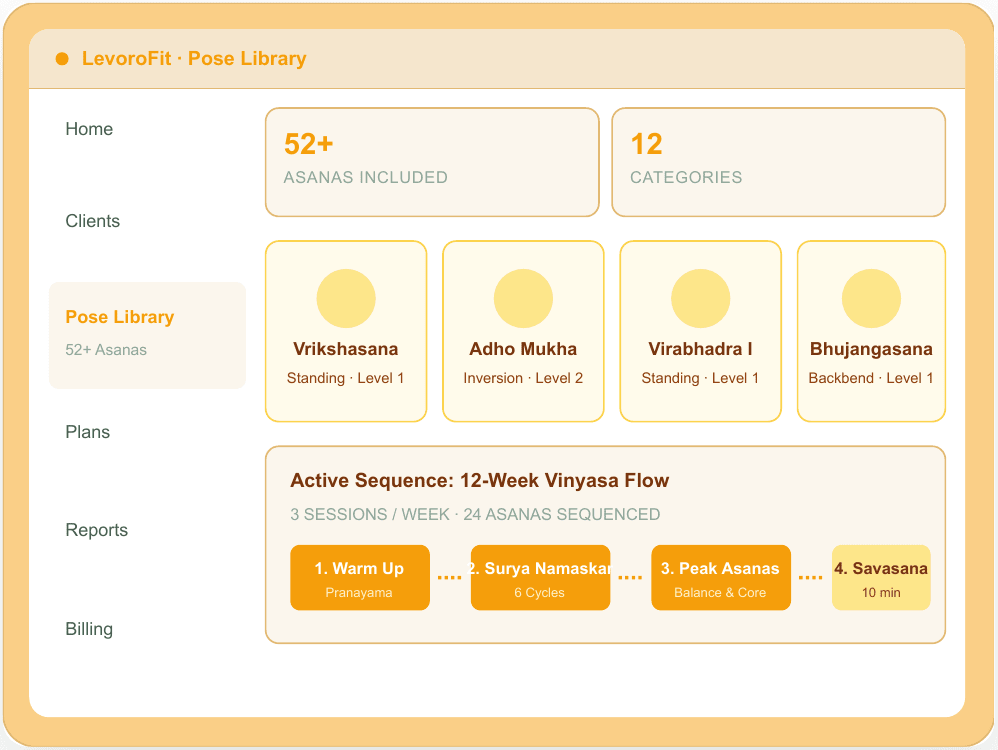
A more complete platform can connect different parts of the student's experience. LevoroFit's yoga offering is designed around this broader approach, bringing classes, instructors, practitioner progress and personalised nutrition support together in one white-label platform. That means the focus isn't only: "Who booked today's class?"It can also be about: "How is this student progressing?"
Beyond Booking: Nutrition and Wellness
Yoga and wellness often go beyond the studio floor. For studios that want to offer a more complete wellness experience, LevoroFit includes nutrition capabilities such as Sattvic and yogic meal plans, energy-focused meal guidance for practice days, pre- and post-class nutrition suggestions, and integration with student wellness data.
This creates a broader journey: Yoga practice + Nutrition + Progress + Wellness
Instead of managing these areas separately a studio can bring them into one platform.
What About White-Label Yoga Software?
Here's another consideration for growing yoga businesses:
Your brand.
Imagine you have built a yoga studio with its own:
- · Logo
- · Colours
- · Name
- · Community
- · Teaching style
You may want your digital experience to feel like an extension of that brand.
LevoroFit's white-label offering allows studios to use their own logo, colours and domain, along with a branded student mobile app, student portal, emails and notifications. So instead of simply giving your students another booking link, you can create a more consistent branded experience.
Where Does LevoroFit Fit?
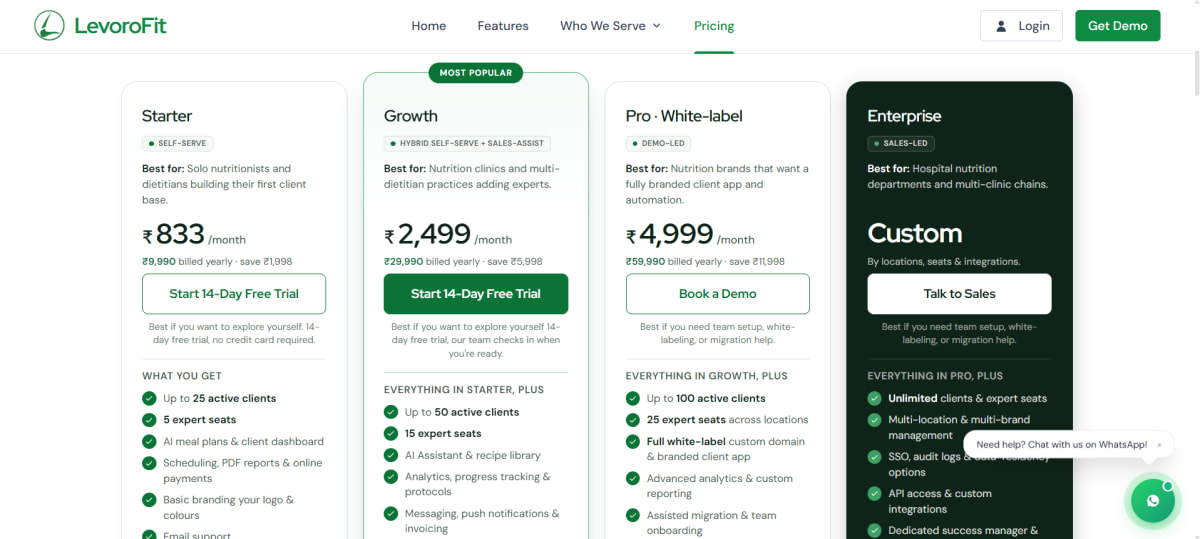
For a small yoga instructor, a free booking system may be enough. But for a yoga business that wants to go beyond basic scheduling, LevoroFit offers a broader platform combining studio management, client management, scheduling, personalised nutrition support and white-label capabilities. The platform also offers a 14-day free trial with no credit card required, so businesses can explore the platform before making a commitment.
The key difference is therefore not simply:
Free vs Paid
It's: Basic booking vs. a more complete business and student-management ecosystem.
So, Should You Choose Free or Paid?
There isn't one answer for every yoga business.
Choose free if:
- · You're just starting
- · You have a small number of students
- · You only need basic booking
· Your operations are simple
Consider paid software if:
- · Your student base is growing
- · You're managing multiple classes
- · You're spending too much time on administration
- · You need more structured student management
- · You want automation
- · You need more advanced business tools
Consider an all-in-one platform if:
- · You want studio management and wellness tools together
- · You want to provide personalised nutrition support
- · You want to track student progress
- · You want a branded digital experience
- · You want your software to grow with your business
The Real Cost Isn't Always the Subscription
For a yoga instructor, the biggest expense isn't necessarily the software subscription.
Sometimes it's the hours spent doing things manually.
- · The spreadsheet.
- · The WhatsApp messages.
- · The payment reminders.
- · The attendance tracking.
- · The follow-ups.
- · The scattered student information.
- Free software can absolutely be useful.
But once your business starts growing, you should evaluate software based on the time it saves, the problems it solves and the experience it creates for your students not just the number on the pricing page.
Final Thoughts
So, is free yoga studio software worth it?
For a solo instructor or small yoga business with simple requirements, yes, it can be a sensible starting point. But free shouldn't automatically mean better.
Before choosing a yoga booking system, ask yourself:
1. How many students do I manage?
2. How much time am I spending on administration?
3. Do I need more than basic booking?
4. Do I want to manage student progress?
5. Do I want to offer nutrition and wellness support?
6. Will my software grow with my business?
The right software isn't necessarily the cheapest one. And it isn't necessarily the one with the longest feature list. It's the one that fits your business today and your plans for tomorrow.
Start simple. Grow smarter. Choose a platform that grows with your yoga business.
Frequently Asked Questions
Is there free yoga studio software?
Yes. Some yoga booking and studio-management platforms offer free plans or limited free functionality. The features, usage limits and conditions vary between providers.
Is free yoga booking software good for solo instructors?
It can be. If you're a solo instructor with a small student base and basic booking requirements, a free solution may be sufficient.
What is a cheap yoga booking system?
A cheap yoga booking system is an affordable platform that helps instructors manage bookings and scheduling. However, it's important to compare the features, limitations and scalability rather than looking only at price.
When should a yoga studio move from free to paid software?
Consider upgrading when your student base, number of classes or administrative workload starts making manual management difficult.
What features should yoga studio software have?
Depending on your business, useful features can include scheduling, online booking, student management, attendance, memberships, payments, automation, progress tracking, analytics, nutrition support and branding.
Is LevoroFit suitable for yoga studios?
LevoroFit currently offers yoga and fitness studio management features including classes, instructor management, practitioner progress and personalised nutrition support, along with white-label capabilities.
⏳ Update History
Last edited by Blog Admin
"Updated via admin form"
Vinay Jindal
Fitness • Health & wellness • Nutrition
Vinay Jindal is a wellness content intern at Levorofit with a keen interest in healthcare technology, digital wellness, nutrition, and preventive health. He enjoys researching how emerging technologies like artificial intelligence are improving healthcare accessibility, patient engagement, and overall well-being. Through his writing, he aims to make complex health and technology topics easier for readers to understand. He enjoys exploring the latest developments in nutrition, fitness, recovery, healthy habits, and digital health to create informative content that empowers individuals to make smarter lifestyle choices. At LevoroFit, Prince contributes educational content that helps fitness professionals, nutrition coaches, and health-conscious individuals stay informed about evolving trends in health, wellness, and nutrition.