
Software for Independent Yoga Teachers in India: Features, Benefits & How It Works
Managing classes, UPI payments and attendance on WhatsApp and Sheets? Here's how software for independent yoga teachers in India saves hours every week.
Software for Independent Yoga Teachers in India: Features, Benefits & How It Works

Running an independent yoga practice in India can look simple from the outside. You teach a class, students leave feeling lighter, and the day is done. In reality, the class itself is often the smallest part of the workload. Behind every session there are WhatsApp messages to answer, UPI payments to match against student names, attendance to note down, packages to renew, and schedules to update, usually late in the evening after a full day of teaching.
If you have been managing all of this through WhatsApp groups, Google Sheets, and payment screenshots, software for independent yoga teachers is the fix. A good yoga instructor platform brings these tasks into one system, so you spend less time on admin and more time on the thing you actually trained for: teaching. In this guide, we explain what this software is, how it works, who it is for, and what Indian yoga teachers should look for. We also show how Levorofit supports independent instructors who want to run a professional, organized, and growing practice.
In short: a yoga instructor platform is software that handles scheduling, bookings, memberships, payments, attendance, student records, and reporting for independent yoga teachers, all in one place. Software for independent yoga teachers pays off most once you teach several classes a week, collect payments from multiple students, or plan to grow beyond a one-person operation. Levorofit is built as exactly this kind of platform for Indian yoga teachers, with GST-native billing and a few extra layers, like nutrition and at-risk student detection, designed specifically for yoga.
What Is a Yoga Instructor Platform?
A yoga instructor platform is software that helps independent teachers manage the business side of their practice from one place. Instead of juggling spreadsheets, calendar apps, WhatsApp groups, payment apps, and paper attendance sheets, you use a single system where your classes, students, and payments are all connected. You will also see it described as software for independent yoga teachers, and, when a teacher runs or rents a space, as yoga studio software.
Most yoga instructor platforms cover a familiar set of functions:
Scheduling: creating recurring and one-time classes, workshops, and events
Bookings: letting students reserve spots online without you confirming each one
Memberships and packages: managing class packs, unlimited plans, renewals, and expiry dates
Payments and billing: tracking who has paid, what is due, what is overdue, and issuing GST-ready invoices
Attendance: recording who showed up and how often
Student records and communication: keeping contact details, notes, and messages together
Reports: showing attendance, revenue, and membership trends over time
You may also see it called yoga studio management software, yoga management software, or yoga business software. The names differ, but the purpose is the same: to help you run your teaching business without drowning in manual work.
It helps to think of it as the operations layer of your yoga practice. Your teaching is what students come for. The platform is what makes sure they can find your classes, book a spot, pay without friction, and feel looked after between sessions. Levorofit is built to be exactly this layer for independent yoga teachers and small studios in India.
What Independent Yoga Teachers in India Handle Without Software
Teaching on your own takes more than excellent teaching. As an independent yoga teacher, you are the instructor, the receptionist, the accountant, the marketer, and the customer support team, all at once. On any given week you may be managing:
Class scheduling and last-minute changes
Student bookings and waitlists
UPI payments, class packages, and memberships
Attendance tracking
Student communication across WhatsApp, calls, and messages, with reminders and follow-ups
Online and offline classes running side by side
Workshops, retreats, and special sessions
Marketing and promotions
Student retention and re-engagement
Business reporting and basic bookkeeping
None of these tasks is difficult on its own. The challenge is volume. Ten small tasks, repeated every week across dozens of students, add up to hours of work that never appear on your schedule but always take time from your day.
A Typical Week Without a Yoga Instructor Platform
Consider a solo instructor in India teaching eight classes a week to around forty regular students. Over the week, they might reply to a dozen WhatsApp messages asking whether a class has space, update a spreadsheet after each session, scroll through UPI payments to see who has paid for the month, send individual reminders about expiring packages, and rearrange a class time by messaging everyone separately. Each step feels minor. Together, they can quietly consume several hours every week, and every one of them is a chance for something to be missed.
That is the point at which many instructors realise the business has outgrown the tools they started with.
Five Foundations of a Well-Managed Yoga Practice
An organised, sustainable yoga practice rests on five foundations. Get these right, and everything else becomes easier to manage.
A clear, reliable schedule. Students should always know when and where your classes take place, and changes should reach them quickly.
An easy way to book and pay. The fewer steps between a student deciding to attend and securing their spot, the more classes you fill.
Accurate records. Attendance, memberships, and payments should be recorded as they happen, not reconstructed at the end of the month.
Consistent communication. Reminders, updates, and follow-ups keep students informed and connected to your community.
Regular review. A short weekly or monthly look at attendance, revenue, and renewals shows you what is working and what needs attention.
Each of these is possible to do by hand, but together they take real time. Making these five foundations run smoothly in the background is exactly where a yoga instructor platform helps. It handles the repetitive parts of scheduling, booking, record-keeping, and communication, so your practice does not end up running you. Levorofit brings all five foundations together in one dashboard, so none of them depend on you remembering to check a separate app.
The Hidden Cost of Managing Everything Manually
Manual systems rarely fail all at once. They fail in small, easy-to-ignore ways that slowly cost you time, money, and student goodwill.
Lost time: Hours spent on admin are hours not spent on lesson planning, personal practice, rest, or building new programmes.
Missed revenue: A forgotten renewal reminder or an untracked payment can mean income you never collect.
Double bookings and confusion: When bookings live in messages and calendars, it is easy to over-fill a class or lose track of who is coming.
Inconsistent student experience: Some students get a prompt reply; others wait. Some receive reminders; others do not.
No clear picture of the business: Without connected data, it is hard to answer basic questions such as which class is most popular, which students have stopped coming, or how much revenue came from memberships this month.
Burnout: Constant administrative pressure on top of teaching is one of the fastest routes to exhaustion for independent instructors.
The goal of good yoga business software is not to make your business feel corporate. It is to remove the friction so that the personal, human side of your teaching has room to breathe.
Why Independent Yoga Teachers Need a Yoga Instructor Platform
Large studios treat administrative software as a given. Independent teachers often manage everything manually, and at first that works. But as your student base and class schedule grow, manual processes start to create problems. This is where software for independent yoga teachers becomes genuinely useful, and where yoga management software starts saving hours every week.
Managing Class Schedules with Yoga Studio Scheduling Software
Yoga studio scheduling software helps you organise recurring classes, manage available slots, and keep your schedule easy to maintain. Instead of updating calendars and messaging students each time something changes, you make the change once, and it is reflected everywhere your students look.
Online Yoga Class Bookings with Yoga Studio Booking Software
Yoga studio booking software lets students reserve their spot without you confirming every booking by hand. That means fewer "Is there space in tomorrow's class?" messages, fewer double bookings, and a smoother experience for students who want to book at any hour, including late at night when you are not available to reply.
Payments and Memberships
Collecting payments manually gets harder as your student base grows, especially when money arrives through UPI, bank transfers, and cash from different students on different dates. A yoga instructor platform helps you organise memberships, recurring payments, class packages, and student records in one place, so you always know who has paid and whose renewal is coming up.
Attendance Tracking
Attendance tells you a lot about student participation. Instead of paper registers or spreadsheets, you can track attendance digitally and see which students come regularly and which are drifting away. Over time, this becomes one of the most valuable sources of insight in your business.
How Does a Yoga Instructor Platform Work?
The easiest way to understand how the platform works is to follow a student through your practice. We can think of it as supporting five connected stages:
Teach → Schedule → Book → Manage → Retain
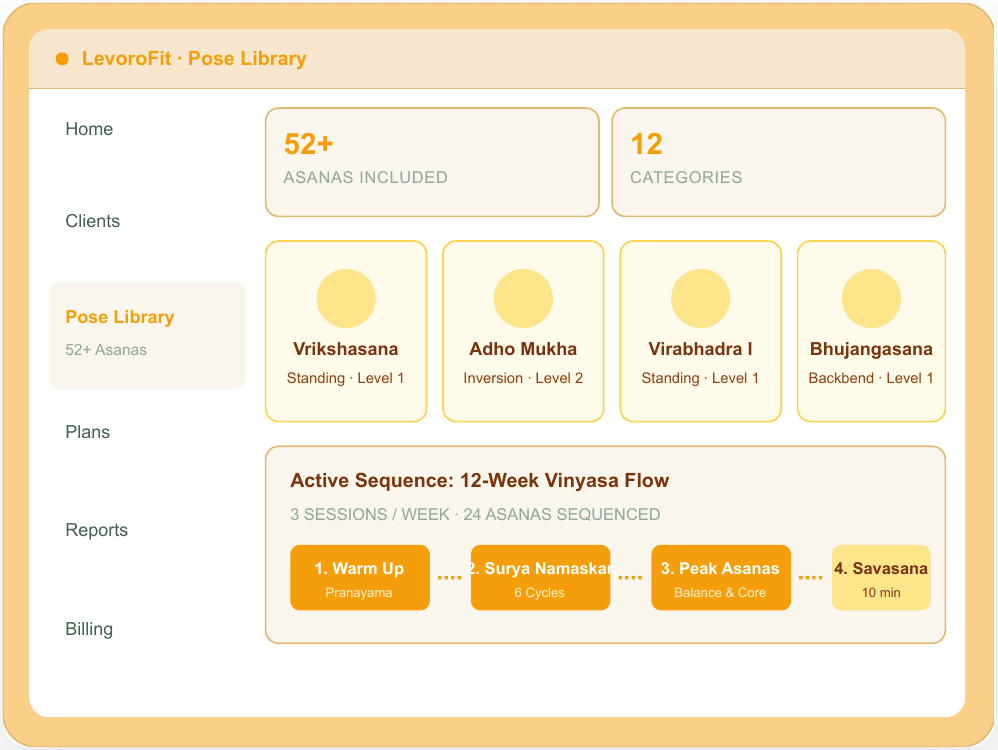
Teach: You plan and deliver your classes, workshops, and programmes. Some platforms also offer teaching support tools, such as a pose library, to help with class preparation and student guidance.
Levorofit Pose Library: build practice plans from 52+ categorised asanas
Schedule: With yoga studio scheduling software, you set up recurring classes, one-time events, and available slots once. Instead of editing calendars and messaging students each time something changes, you update the schedule in one place.
Book: With yoga studio booking software, students browse your schedule and reserve spots themselves. This removes the back-and-forth of "Is there space tomorrow?" messages and gives students a smooth, self-service experience.
Manage: Memberships, class packages, payments, attendance, and student records are updated in one system. You can see who has paid, whose package is about to expire, and who attended which class.
Retain: Attendance patterns and reports help you notice which students are engaged and which are drifting away, so you can reach out before they stop coming altogether.
The real value comes from these stages being connected. A booking updates attendance. Attendance feeds your reports. Reports help you decide where to focus your energy and how to keep your students. When each step lives in a different tool, you become the connector, copying information from one place to another. When the stages sit inside one platform, the software does that work for you. Levorofit's entire workflow is structured around this exact Teach → Schedule → Book → Manage → Retain flow, rather than treating them as separate modules.
Online and Offline Classes in One Place
Many independent instructors now teach a mix of in-person and online classes. Managing both through separate tools creates extra confusion for students and extra work for you. A good platform lets you list all of your classes in one schedule, so students can choose the format that suits them and you can see your entire business at a glance.
Who Needs Software for Independent Yoga Teachers?
This type of software is not only for people who own a studio. It is built just as much for solo teachers as for larger studios, and it is most useful for:
Solo yoga instructors teaching multiple weekly classes and managing their own bookings and payments
Independent teachers running online and offline classes together
New instructors who want to build good systems from day one rather than fix a messy process later
Workshop and program leaders who organise special sessions, series, or seasonal programs
Instructors with growing memberships who are finding it hard to track renewals and expiries
Small studios and teachers planning to grow beyond a one-person operation and add other teachers
Yoga teachers in India who need GST-ready billing as part of their everyday workflow
Solo Yoga Instructors in India
If you teach on your own, you do not have anyone to hand admin to. Good software for independent yoga teachers effectively becomes your assistant, handling the repetitive parts of the job so that you can stay focused on students. This matters even more in India, where many teachers run their practice across WhatsApp groups, UPI payments, and home or rented-space classes, with nothing connecting them. A yoga instructor platform replaces that patchwork, which is why yoga studio management software for solo instructors is becoming a standard part of a professional teaching practice.
Small Studios and Growing Teachers
As soon as you consider bringing in a second teacher, renting a space, or launching a larger program, the cost of disorganised systems increases sharply. Choosing yoga studio software for small studios early makes growth smoother, because your data, your students, and your processes are already in order.
Who May Not Need It Yet
Software is not necessary for everyone at every stage. If you teach a handful of students, take payments rarely, and a calendar plus a simple spreadsheet still covers everything comfortably, simple tools may be enough for now. The signs in the "When Should You Start" section below will tell you when that changes.
Features to Look for in Software for Independent Yoga Teachers
Not every instructor needs a complex platform. The right solution depends on the size and type of your practice. When comparing platforms, these are the features that matter most and why. For teachers in India, we have also flagged what to check locally and, where relevant, how Levorofit handles each one.
Class Scheduling
You should be able to create recurring weekly classes as well as one-time workshops without repeating the same setup every time. This is the core job of yoga class scheduling software: look for the ability to edit a single session, cancel a class, or change a time without disrupting the rest of the schedule.
Booking Management
Students should be able to reserve available spots without unnecessary back-and-forth. Good yoga studio booking software — sometimes searched as yoga class booking software — shows availability clearly, respects your class capacity, and reduces the number of manual confirmations you need to make.
Membership Management
Look for support for class packs, monthly memberships, renewals, and expiry tracking, along with student records that sit alongside them — this is what yoga membership management software is built to handle. This is where many spreadsheets fall apart, because renewal dates are easy to miss when you track them by hand.
Attendance Tracking
A simple attendance system helps you monitor participation without paper registers. Over time, this data shows who attends regularly, which classes are most popular, and where interest is dropping.
Payment Management
Payment tracking and billing should be integrated into your overall workflow wherever possible. If you are in India, check whether the platform supports GST-compliant invoicing so that you do not need a separate billing tool, and whether it fits the way your students already pay you, such as via UPI or bank transfer. Levorofit includes GST-native billing for this reason.
Student Communication
Automated or centralised communication reduces repetitive work such as reminders, announcements, and follow-ups. It also makes sure every student receives the same level of care. If most of your students live on WhatsApp today, look for a platform that keeps communication in one place so nothing gets lost in a chat thread.
Reporting and Business Insights
Basic reports on attendance, memberships, revenue, and student activity help you make decisions with facts rather than guesses. You do not need advanced analytics, but you should be able to see how your business is performing at a glance. Levorofit's AI Assistant surfaces these patterns for you rather than leaving you to build your own reports.
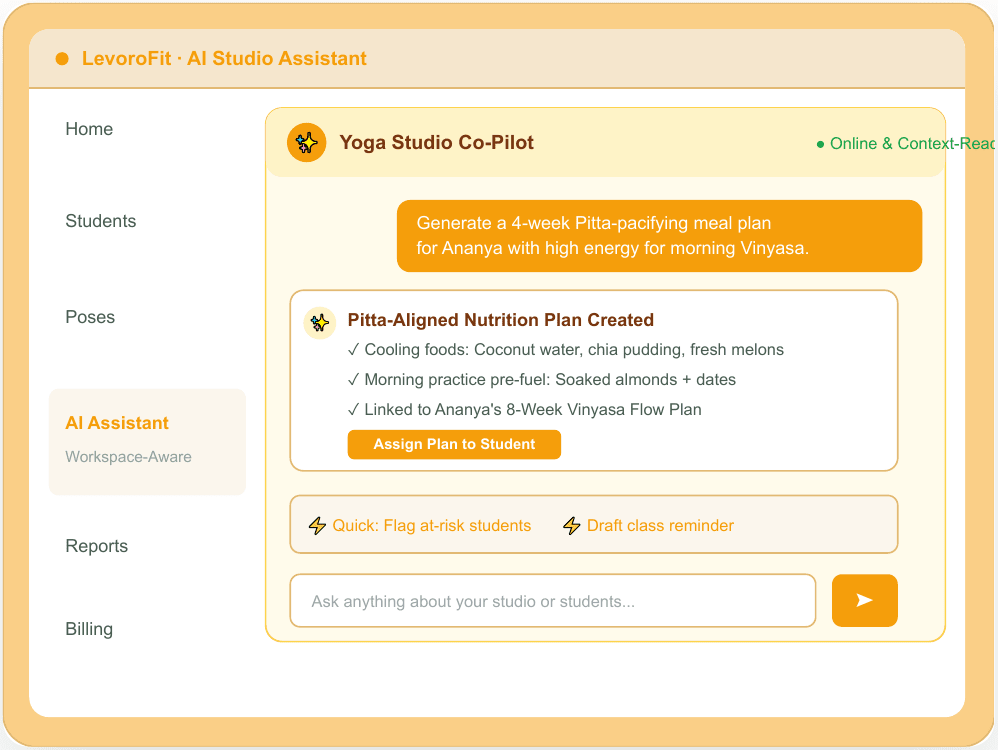
Levorofit AI Studio Assistant: meal plans, at-risk student insights and follow-up drafts
Ease of Use
A platform that is difficult to learn will not get used. For a solo instructor, simplicity matters more than a long list of features. Look for a clean interface that you and your students can pick up quickly, including on a phone.
Free Tools vs. a Paid Yoga Instructor Platform
A new instructor may initially prefer free tools such as spreadsheets, calendars, WhatsApp groups, and basic booking forms. This is a perfectly reasonable place to start. When you only have a small number of students, these tools can do the job without any cost.
The trouble begins as you grow. Each free tool solves one problem, but none of them talk to each other. You update a spreadsheet, then a calendar, then send a message, then open a payment app to check who has paid. Information slips through the gaps, and you become the human link between five separate systems.
Dedicated yoga studio software brings scheduling, bookings, memberships, attendance, payments, and student management together in one place. That is where the real saving comes from: not from any single feature, but from removing the need to repeat and reconcile information across several tools.
So the question is not simply whether free software is available. The more important question is whether the tools you are using are saving you time or creating more work. If you spend more time maintaining your system than benefiting from it, the free option has stopped being free. This is the gap Levorofit is built to close.
When Should a Solo Instructor Start Using Yoga Business Software?
There is no fixed number of students at which every instructor needs software. However, yoga business software becomes increasingly valuable when:
You are managing multiple weekly classes.
Students frequently ask about available slots.
You are tracking payments manually.
Membership renewals are getting difficult to monitor.
Attendance is maintained through spreadsheets or paper.
You are spending a significant amount of time on administrative tasks.
You want to introduce workshops or new programmes.
You are planning to grow beyond a one-person operation.
If several of these sound familiar, it is probably time to make the switch. Moving earlier is usually easier than moving later, because you have fewer records to transfer and fewer habits to change. Levorofit's setup is designed to take a few minutes, so switching does not mean losing a week of teaching time to admin.
How Levorofit's Yoga Instructor Platform Supports Independent Yoga Teachers in India
We built Levorofit to be more than a booking tool. It is a yoga instructor platform and software for independent yoga teachers that connects the business side of your work with teaching and student support so that it covers the full Teach → Schedule → Book → Manage → Retain journey in one platform.
Levorofit is designed to reduce repetitive admin, improve visibility into student engagement, and help instructors stay on top of renewals and follow-ups.
Instead of focusing only on bookings and scheduling, Levorofit brings yoga business management, teaching support, and student engagement together, connecting operational management with features designed around how yoga businesses actually run:
Student management to keep student records and progress in one place
Billing and management features, including GST-native billing for Indian yoga businesses, so invoicing does not need a separate tool
At-risk student detection to help you spot students who may be slipping away, so you can reach out before they stop coming
Pose Library to support your teaching and class preparation
Session highlights challenges to capture and share what happened in a class
Daily Challenges to keep students engaged with their practice between classes
AI assistant to help with everyday tasks and save you time
Nutrition-related capabilities to support students beyond the mat
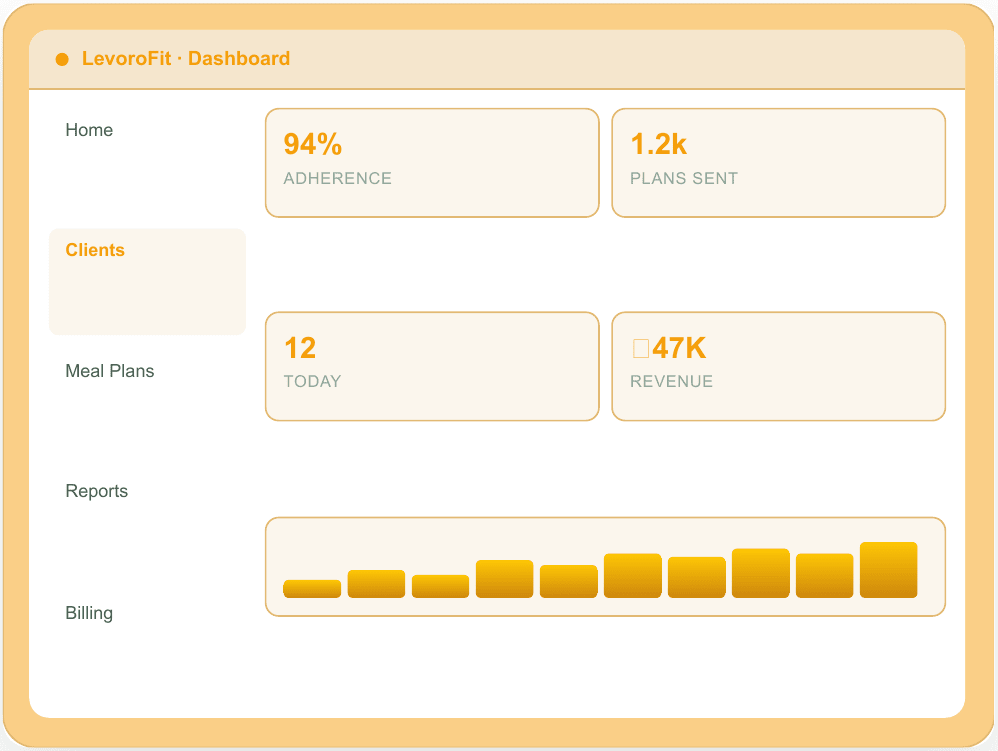
Levorofit dashboard: student records, plans and revenue in one place
Beyond a Basic Booking System
Many tools stop at scheduling and payments. That solves the administrative side but leaves the relationship side to you. Levorofit is built around the idea that running a yoga business is not just about filling classes. It is about helping students stay consistent, feel supported, and keep coming back. Features such as at-risk student detection, session highlights, and daily challenges exist to support that ongoing relationship, not just the transaction.
Built with Indian Yoga Businesses in Mind
For instructors in India, billing is often a separate headache. GST-native billing means invoicing is part of the platform rather than an extra step handled in another tool. That keeps your student records, payments, and invoices connected in one place. If you have been tracking payments across UPI apps, bank transfers, and a spreadsheet, having students, bookings, payments, and invoices together takes most of the month-end reconciliation off your plate.
Explore the full feature set on the Levorofit yoga studio software page, or see 27 Easy Ways to Keep Your Yoga Students Coming Back for more on retention. If you want to see how Levorofit stacks up against other platforms feature-by-feature, our comparison of 7 yoga studio management software platforms breaks it down side by side.
How to Get Started with a Yoga Instructor Platform: A 30-Day Plan
Moving to a new system does not have to be disruptive. A gradual, structured approach keeps your classes running smoothly while you make the switch.
Week 1: Gather and Decide
List your current classes, students, memberships, and payment methods. Decide what you want the software to solve first, whether that is bookings, payments, or attendance. Clarity at this stage prevents you from trying to change everything at once.
Week 2: Set Up Your Schedule and Offers
Enter your recurring classes, workshops, packages, and memberships. Check that capacities, timings, and prices are accurate before any student sees them.
Week 3: Bring In Your Students
Import or add your existing student list and let students know about the new booking process. A short, friendly message explaining what is changing and why it makes things easier for them goes a long way.
Week 4: Run, Review, and Adjust
Run your classes through the new system, then review what worked. Look at attendance, bookings, and payments, and adjust your setup where needed. By the end of the month, most of the manual admin you started with should already be gone.
A Weekly Routine for Running Classes on a Yoga Instructor Platform
Software works best when it supports a simple routine. Here is a practical weekly rhythm a solo instructor can follow inside Levorofit — or any similar platform — to keep admin from piling up.
Start of the Week: Plan
Check the week's schedule, confirm class capacities, and make sure any workshops or special sessions are listed. Fix anything that has changed so students always see the correct information.
During the Week: Teach and Track
Let bookings come in on their own. After each class, mark attendance so your records stay accurate without needing a catch-up session later. This takes seconds per class when done immediately and hours when left to the end of the month.
End of the Week: Review and Follow Up
Look at which memberships or packages are close to expiry, which payments are pending, and which regular students have missed recent classes. A short, friendly message at this stage can make the difference between a student renewing and quietly disappearing.
Once a Month: Look at the Bigger Picture
Review attendance by class, revenue by source, and student retention. Decide whether to add a class, change a time slot, launch a workshop, or adjust your offers. Ten minutes with clear numbers is more useful than hours of guesswork.
Running your business this way turns admin from a constant background worry into a small, predictable part of the week.
Common Mistakes When Choosing or Switching to Yoga Studio Software
Running everything from memory. Relying on your head or scattered notes for bookings, payments, and renewals works until it suddenly does not.
Not tracking renewals. Missed renewals are one of the most common and most avoidable sources of lost income.
Ignoring students who go quiet. A student who stops attending rarely announces it. Watch attendance patterns and reach out early.
Using too many disconnected tools. Every extra app adds another place to update and another chance for information to go missing.
Switching everything overnight. Introduce a new system in stages so students are not confused.
Not telling students about changes. New booking or payment processes only save time if students actually use them, so communicate clearly.
Never reviewing the numbers. Reports are only useful if you look at them. Set aside a few minutes each week.
Waiting too long to get organised. The longer you rely on scattered tools, the more records you have to move later.
Most of these mistakes come from tools that do not talk to each other. Levorofit avoids that problem by keeping scheduling, bookings, payments, and attendance in one connected system from day one.
Yoga Business Metrics Every Solo Instructor Should Track
One of the biggest advantages of centralised software is that useful numbers appear automatically. Good yoga business management does not require you to become a data analyst, but a few simple metrics can guide your decisions — Levorofit's dashboard and at-risk student detection surface most of these without any manual tracking:
Class attendance: which classes fill up and which struggle
Membership renewals: how many students renew, and how many lapse?
Revenue by source: memberships, class packs, drop-ins, and workshops
Student retention: how many students keep attending month after month?
New versus returning students: whether your community is growing or simply circulating
Looking at these each week or month helps you see patterns early. If evening attendance is dropping, you can adjust the schedule. If renewals are slipping, you can send a reminder or a personal message before students disappear.
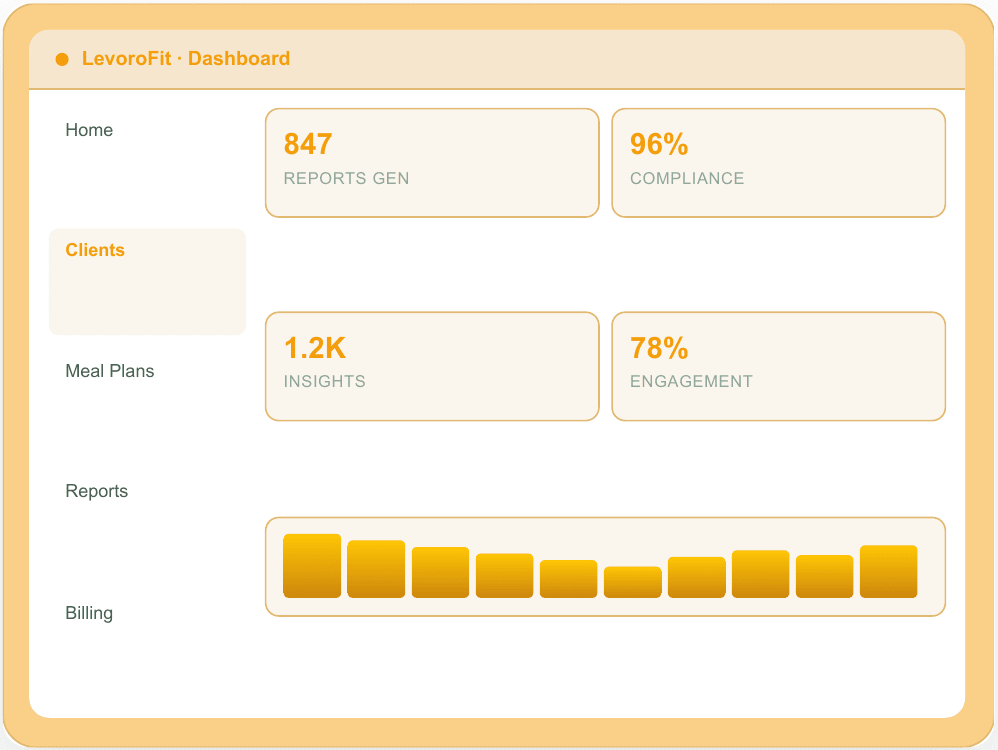
Levorofit reports: attendance, engagement and progress at a glance
How a Yoga Instructor Platform Supports Growth
The purpose of a yoga instructor platform is not only to automate administrative tasks. It also creates a more organised, professional experience for both you and your students. A centralised platform helps you manage the complete student journey: booking a class, attending sessions, maintaining a membership, and continuing their practice with you.
When that journey is smooth, students are more likely to stay. And in a solo yoga business, retention matters more than almost anything else. It is far easier to support the students who already trust you than to constantly find new ones. Software helps by making it easy to notice who needs attention, celebrate consistency, and keep your community engaged.
Growth decisions also become easier when the data is already in front of you, rather than something you have to reconstruct from memory or spreadsheets. The software's job here is narrow but useful: it surfaces what is actually happening in your classes, so you are working from evidence, not guesswork:
Which time slots consistently fill up, so you can see where there is room for another class
Which students have not attended in a while, so you can re-engage them before they lapse?
How memberships and class packages are renewing, so you know what is working
How engaged students are between classes, through tools like Daily Challenges and shared Session Highlights
For the broader question of how to build and grow a profitable yoga business — pricing, corporate tie-ups, retreats, and other revenue strategies — see our dedicated guide: 25 Ways for Managing and Building Profitable Yoga Business.
Frequently Asked Questions
Do independent yoga teachers really need a yoga instructor platform?
Not always at the very beginning. If you have only a few students, simple tools may be enough. But once you are teaching several classes a week, collecting payments from multiple students, or tracking memberships, software for independent yoga teachers can save significant time and reduce mistakes.
What is a yoga instructor platform?
A yoga instructor platform is software that lets independent yoga teachers manage classes, bookings, memberships, payments, attendance, and student records from one place, instead of spreadsheets and chat groups. It is the same idea as software for independent yoga teachers, built around one person running the practice rather than a large studio team.
What should Indian yoga teachers look for in software for independent yoga teachers?
Beyond core scheduling, booking, and membership features, look for GST-ready billing, a mobile-friendly experience for you and your students, a setup you can finish without technical help, and a plan that suits a one-person practice. Levorofit is built with Indian yoga teachers in mind, including GST-native billing.
What is the difference between yoga studio software and yoga management software?
In practice, the terms are used interchangeably. Both refer to platforms that help yoga teachers and studios manage scheduling, bookings, memberships, payments, attendance, and student records. You may also see them described as yoga business software or a yoga instructor platform.
Can I use it for both online and in-person classes?
Yes. A good platform lets you manage online and offline classes in one schedule, so students can choose the format they prefer, and you can see your full business in one view.
Is it hard to switch from spreadsheets?
It does not have to be. Most instructors move gradually, starting with their schedule and student list and adding memberships and payments as they get comfortable. A simple four-week plan, as outlined above, makes the transition manageable.
Is yoga studio management software only for large studios?
No. Solo instructors, independent teachers, small studios, and multi-teacher businesses can all use the same kind of platform. Larger studios simply use more of it at once, such as multiple teacher logins or multi-location reporting; a solo instructor can start with just scheduling, bookings, and payments and add more as the business grows.
Can yoga studio management software replace spreadsheets entirely?
For most day-to-day tasks, yes. Scheduling, bookings, attendance, memberships, and payments can all move into one connected system. Instructors typically migrate gradually rather than all at once — see the 30-day plan above.
Can I run a yoga business without a physical studio?
Yes. Many independent instructors teach online, outdoors, or in rented spaces. The business side stays the same wherever you teach: you still need a schedule, bookings, payments, and attendance records. Yoga studio management software lets you manage all of it in one place, whether classes are online, in person, or both.
How do I keep track of student attendance, payments, and memberships?
The simplest approach is to use one system for all three, rather than a separate spreadsheet, payment app, and register. When attendance, payments, and memberships are connected, you can see at a glance who has paid, who is due for renewal, and who has stopped attending.
How can I keep students coming back to my classes?
Consistency is built through small, regular touchpoints: a smooth booking experience, timely reminders, personal follow-ups when someone misses classes, and ways to stay engaged between sessions. Attendance data helps you notice who is drifting away early enough to reach out.
Does Levorofit support GST billing?
Yes. Levorofit includes GST-native billing designed for Indian yoga businesses, so invoicing can sit inside the same platform as your students, bookings, and payments.
What makes Levorofit different from a basic booking tool?
A basic booking tool handles scheduling and reservations. Levorofit also connects student management, billing, at-risk student detection, a Pose Library, Session Highlights, Daily Challenges, an AI Assistant, and nutrition-related capabilities, supporting the wider work of teaching and retaining students.
Final Thoughts
Running a solo yoga business gives you the freedom to build your own teaching style and student community. It also means taking responsibility for the administrative side of the business, and that side grows quietly as your classes and students do.
The right yoga instructor platform can reduce repetitive work, organise student information, simplify scheduling and bookings, and give you a stronger foundation for growth. For a brand-new instructor, simple tools may be enough in the beginning. But as classes, students, memberships, and responsibilities increase, moving to dedicated software for independent yoga teachers can make your practice easier to manage and easier to scale. For Indian teachers, yoga management software with GST-ready billing also keeps the paperwork clean from day one.
An organised practice comes down to a few habits: keep your schedule clear, make booking and payment easy, track attendance and renewals as they happen, and stay in touch with your students. Software makes those habits far easier to keep.
Your students come for your teaching. The right system simply makes sure everything around it runs as smoothly as your classes do.
Ready to spend less time on admin and more time teaching?
Join growing yoga and wellness practices using Levorofit to manage classes, bookings, and students.
Start Your 14-Day Free Trial → No credit card required. Set up your first class in about 5 minutes.
Book a Demo → See scheduling, billing, and student management on a real studio workspace with our team.
No credit card required · Dosha-aligned plans · Cancel anytime · 24/7 support
Explore Levorofit's plans and product details before choosing the setup that fits your practice.
About the Author
Vinay Jindal writes about technology and business tools for yoga and fitness professionals at Levorofit. He focuses on helping independent teachers and small studios in India cut down admin work, stay organised and grow their practice.
⏳ Update History
Last edited by Blog Admin
"Updated via admin form"
Vinay Jindal
Fitness • Health & wellness • Nutrition
Vinay Jindal is a wellness content intern at Levorofit with a keen interest in healthcare technology, digital wellness, nutrition, and preventive health. He enjoys researching how emerging technologies like artificial intelligence are improving healthcare accessibility, patient engagement, and overall well-being. Through his writing, he aims to make complex health and technology topics easier for readers to understand. He enjoys exploring the latest developments in nutrition, fitness, recovery, healthy habits, and digital health to create informative content that empowers individuals to make smarter lifestyle choices. At LevoroFit, Prince contributes educational content that helps fitness professionals, nutrition coaches, and health-conscious individuals stay informed about evolving trends in health, wellness, and nutrition.